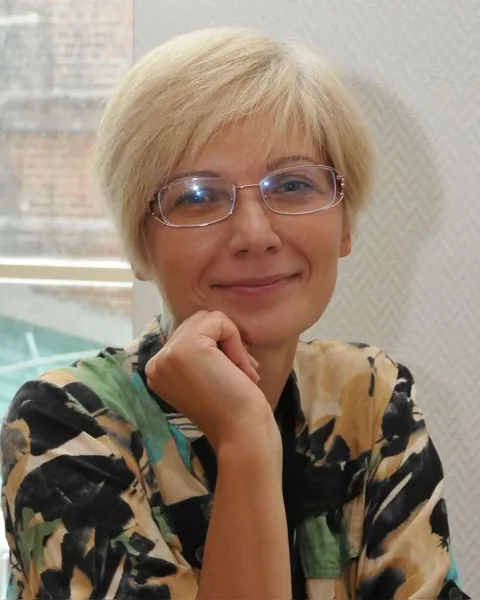
Sajina Nelly
Main achievement
Artist on ceramics and easel
About
Nelly Sajina (1938-1996) was one of the most significant ceramicists and sculptors of the Republic of Moldova, indelibly marking the artistic landscape of her era through monumental works and high-quality plastic experimentation. After moving to Chisinau in 1946 with her parents, she pursued specialized studies at the Mukhina Institute of Art and Industry in Leningrad (1960-1966), where she studied ceramics and glass under the guidance of renowned professors. Returning to Moldova in 1967, she integrated into the Art Fund of the Moldavian Republic and became a member of the Union of Artists of the USSR (1969), a position from which she developed a prolific and internationally recognized career. Her creation is distinguished by the duality of a rich artistic language, which combines the figurative traditions of the Leningrad school with the decorative and symbolic elements of Moldovan folk art. Sajina worked in parallel on two main directions: figurative sculptures that revisit mythological and feminine themes, and decorative compositions inspired by traditional Moldovan motifs, in which color and module became essential vectors of artistic expression. Her technical mastery and artistic-philosophical sensitivity were manifested in works such as "The Muses" in the foyer of the Opera and Ballet Theater (1980), "The Tree of Life" in the Palace of Weddings (1986), and "Physics" in the headquarters of the Academy of Sciences (1982), and her participation in the renowned international ceramics competitions in Vallauris (France) and Faenza (Italy) confirmed her reputation among world artistic circles. Her public and monumental art activity did not exclude personal plastic research, in which Sajina explored the relationship between form and color, materiality and metaphor, focusing on the expressive capacity of ceramics as a living and versatile material. Her late works, such as "Păstrătoare" (Keeper) and "Păstrează!" (Keep!), highlight her philosophical concern for the transmission of cultural heritage and the dialogue between the traditional and the contemporary. The tragedy of her fate, which occurred in March 1996, left a lasting artistic legacy that remains present in Moldovan cultural institutions and private collections, and her memory has been honored through dedicated monuments and catalogs that attest to her importance in the evolution of visual arts in the Republic of Moldova.